
Code Verification and Validation
Published in NeurIPS 2026, ACM SIGPLAN LMPL 2026, 2026
As LLMs increasingly translate, migrate, and patch code, the key question is: does the new code still behave like the old code? Passing tests is not enough. Subtle semantic differences can silently change results. This research develops methods to detect behavioral divergence and to measure how much confidence a “no difference found” verdict deserves.
Graph-Grounded Functional Equivalence
This work simulates how an expert test engineer reviews a code change (trace callers and callees, pick inputs that reach risky paths, compare old and new behavior), without building or running the code.
- Grounded reasoning: bounded code-graph queries, where every answer cites a source line.
- Differential surrogates: two blinded LLMs each predict one version’s behavior, and a deterministic reconciler gives the final verdict: EQUIVALENT, INEQUIVALENT, or UNCLEAR.
- Language-agnostic: works on hard-to-execute code such as legacy .NET Framework or COBOL.
- Findings (all confirmed by executing counterexamples): 28.4% of test-passing agent patches on SWE-bench Verified behave differently from the reference fix, and 18% of EquiBench labels are contradicted.
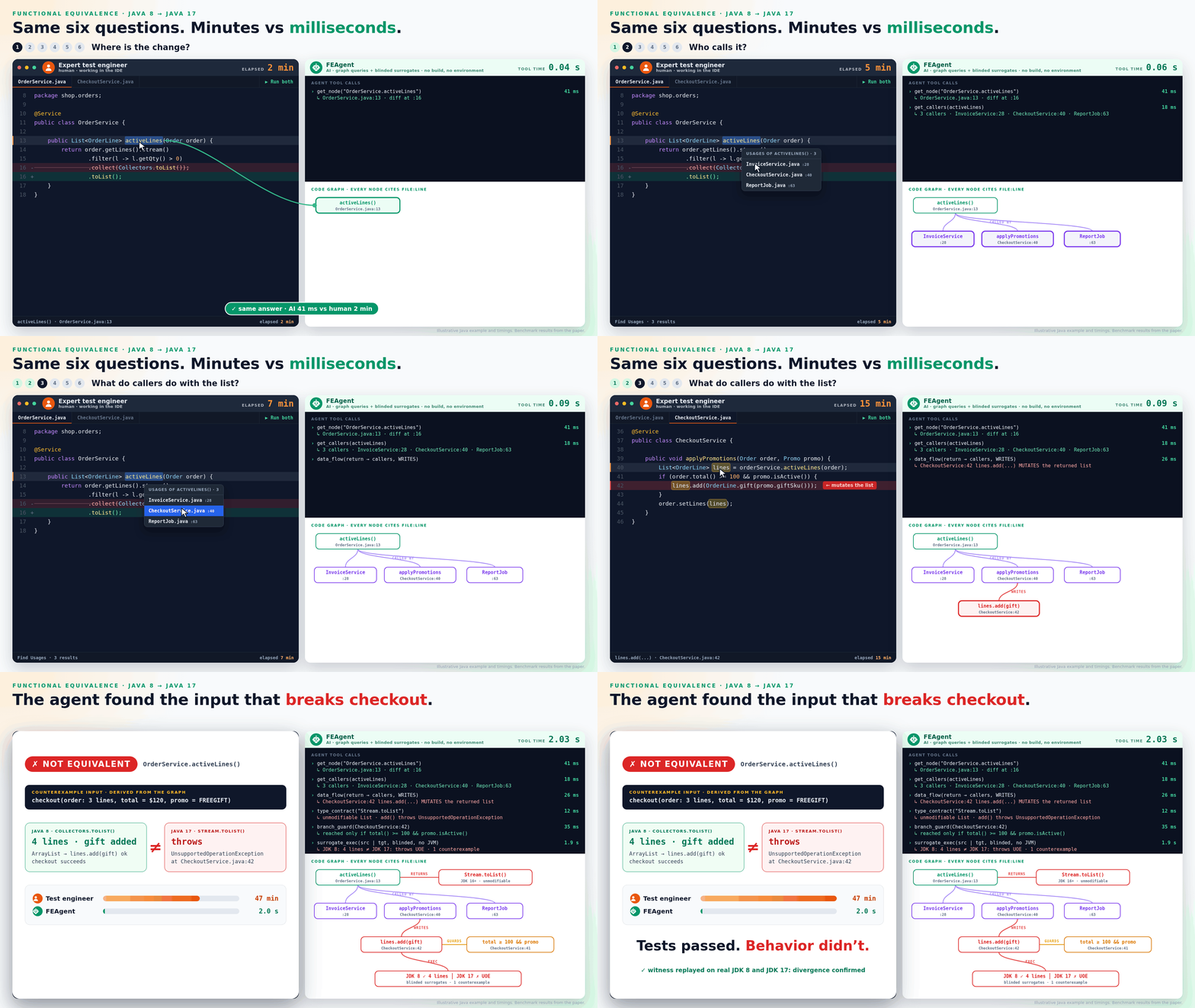
Illustrative demo: an expert test engineer and the agent answering the same six questions about a code change
Mutation-Score-Guided Testing for Database Migration
SQL dialects differ in subtle ways, such as case sensitivity, integer division, and NULL handling, so a syntactically valid translation can still return different results.
- Adversarial LLM loop: one LLM generates test data aimed at exposing differences, while another generates query mutants that try to evade the current tests.
- Confidence, not just pass/fail: the resulting mutation score is calibrated into an estimate of the risk that a non-equivalent pair goes undetected.
- Result: on 1,035 cross-dialect migration pairs, query-aware test generation cut the false negative rate from 58.3% to 20.0%.
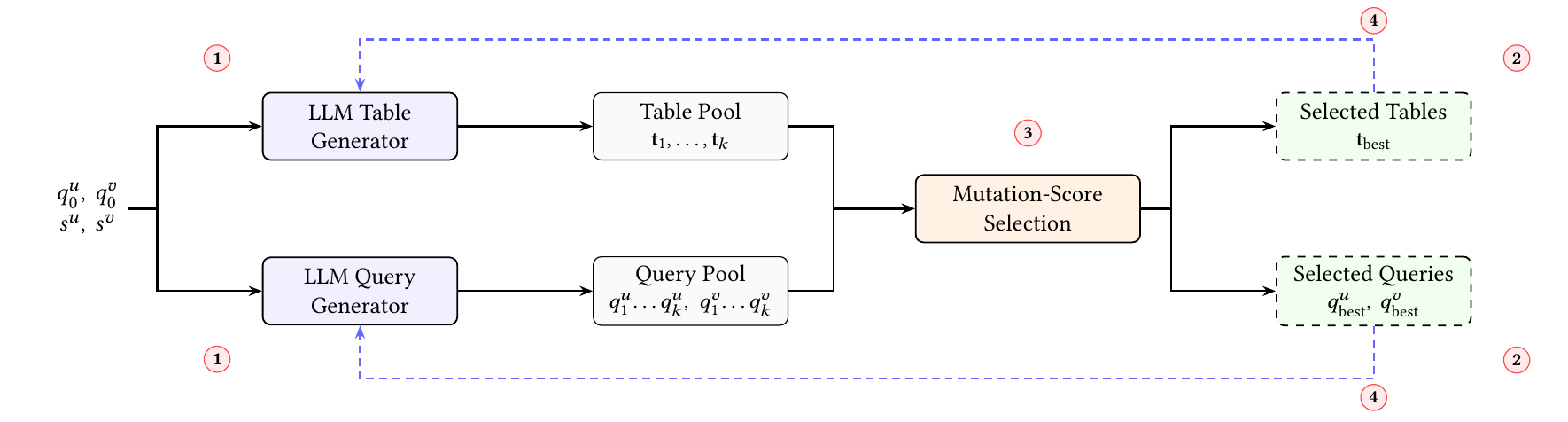
Iterative test data and mutant generation guided by mutation scores